
By Roger M. Rael
The Raton Range
An anonymous sender wanted The Raton Range to examine records concerning William “Cody” Ayon. The documents did not arrive alone. They came with commentary that pushed readers toward a conclusion about Ayon before the underlying reports had been fully examined and before his encounter had been compared with another use-of-force case involving the opposing candidate for Colfax County sheriff.
The records deserve examination. So does the way they were delivered and framed. A document can be genuine while the narrative wrapped around it remains selective, incomplete, or plainly argumentative. Evidence must be separated from the sender’s desired verdict.
The anonymous delivery was not entirely anonymous
The transmission retained network-level information that made it possible to trace an internet address associated with its delivery. The Range will not publish that address or use it to name a private person without independent confirmation.
That limitation matters. Depending on the service used, an email header, server log, cloud-sharing record or other transmission data may preserve an originating internet protocol address, a timestamp, a service provider or a route through which material traveled. A sender using a home or workplace connection without a privacy relay, proxy or virtual private network can leave more of that trail exposed.
But an IP address is not a fingerprint. It can identify a network or subscriber account and sometimes suggest a general location. It does not, by itself, prove who was holding the device, who typed the message or whether the traffic passed through another system. The digital trail is therefore a reporting lead, not a final identification.
For this series, the important point is not to expose a source. It is to disclose that the material was accompanied by an effort to shape its meaning. In my reading, the comments presented accusation as conclusion. That is advocacy, not neutral fact-finding. Calling the packet a witch hunt would also be a conclusion. The responsible approach is to test every claim against the complete record and apply the same standard to both candidates.
What the Ayon records actually establish
The Ayon material concerns a June 26, 2019, encounter with Kevin Hoy at the Loaf ‘N Jug in Raton. The confrontation grew out of a personal accusation communicated through Facebook. According to the reports, Hoy accused Ayon of having an affair with Hoy’s partner. Ayon denied it.
The encounter moved from the store toward a blue sedan. The accounts do not agree on every movement. Ayon reported that Hoy raised a finger close to his face, squared his posture, and presented what Ayon perceived as an imminent battery. Ayon said he knocked Hoy’s hand away and attempted to arrest him. Officer Kenneth Long said he saw Hoy swing at Ayon. Hoy said Ayon followed him after telling him he was free to leave, struck his hand and chin first, and provoked the response.
A civilian witness told Sgt. Bill LaPorte that the brown-uniformed officer appeared to strike first. Another witness could not say who shoved first. LaPorte’s report of the store video said Ayon approached Hoy, stepped closer and struck Hoy in the upper body near the face after Hoy raised his right hand. LaPorte wrote that the video did not clearly show whether Hoy was pointing a finger or precisely where Ayon’s motion landed.
Hoy was handcuffed, complained of wrist and shoulder pain and shortness of breath, and was checked by emergency medical personnel. He refused further medical treatment and transport. He was then booked on two assault-on-a-peace-officer counts and a resisting, evading, or obstructing charge. The records reviewed for this article do not establish the ultimate court disposition of those charges.
The Sheriff’s Office opened Internal Affairs inquiry IA-002. Its evidence list included body-camera recordings, store video, cellphone video, photographs, written statements, and additional interviews. Ayon was served with notice of the investigation after returning from injury and sick leave. He resigned the following day, citing health reasons, before giving the planned administrative interview.
The inquiry therefore closed as “undetermined.” That word is important. It is not a finding that Ayon committed misconduct. It is also not an exoneration. It means the agency recorded no final finding because, according to the report, the investigation could not be completed after his resignation.
The 2007 encounter the packet did not discuss
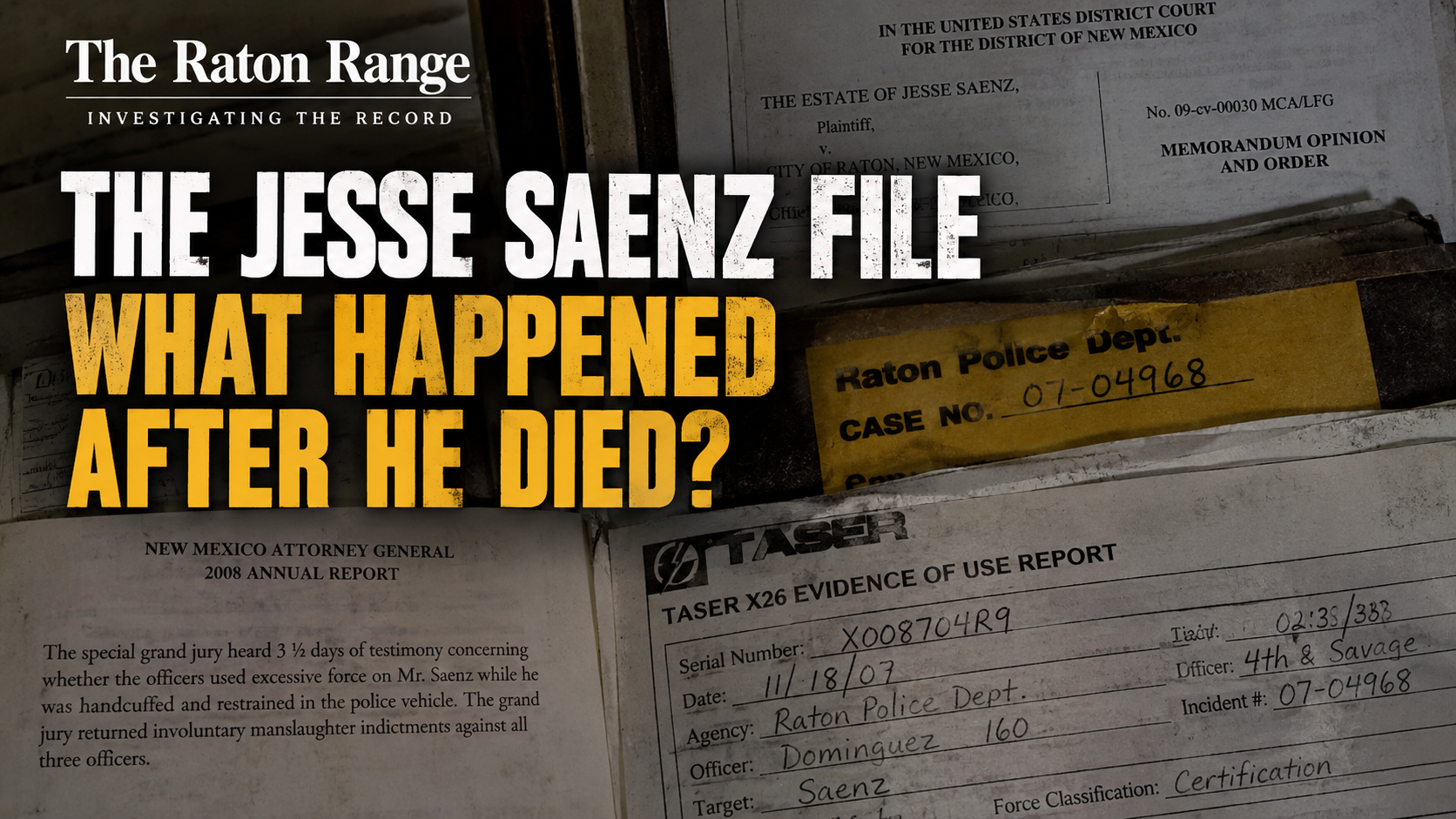
If the public is being asked to evaluate Ayon’s judgment during one disputed arrest, then it is fair to examine a much more severe encounter involving Nolberto “Beto” Dominguez. On Nov. 18, 2007, Jesse Saenz died after an arrest by members of the Raton Police Department. Dominguez was one of the involved officers.
A later federal court order described facts and disputed evidence that are difficult to read and impossible to dismiss as political gossip. The court found probable cause supported Saenz’s arrest for criminal trespass. It also recounted that, during efforts to place him inside a patrol vehicle, Saenz resisted by wedging himself in the doorway and kicking.
The same order states that Dominguez came to assist, opened the opposite door, grabbed Saenz by the torso, and pulled him into the car. Saenz ended up on his stomach in the back seat, with his hands cuffed behind him. His boots were removed, and his ankles were shackled.
Then came the Tasers. The officers’ descriptions and the electronic data did not match. A Taser instructor who reviewed the device printouts testified that Baca’s Taser cycled 10 times and Dominguez’s cycled 11 times. The federal judge ruled that, viewing the evidence in the estate’s favor as required at that stage, a reasonable jury could find that Saenz endured more than 20 electrical cycles while barefoot, shackled, handcuffed behind his back, and lying face down in the patrol vehicle.
The court also recorded a sharply disputed allegation about the ride to the station. Saenz’s estate alleged that Dominguez sat on Saenz’s neck, back and/or buttocks while pulling his shackled ankles toward his cuffed wrists. The defense said Dominguez held Saenz’s legs while keeping his weight off Saenz’s back. The court did not resolve that factual conflict at summary judgment.
The danger associated with prone restraint was not unknown in 2007. A National Institute of Justice bulletin published in 1995 warned that body position can interfere with breathing and that cocaine intoxication, a violent struggle, and face-down restraint can combine to increase the risk of sudden in-custody death.
Saenz died in police custody. A special grand jury later indicted Dominguez, Leonard Baca Jr. and Chris Edmondson on involuntary manslaughter charges. State prosecutors dismissed those charges in 2009 after a new medical investigator concluded that neither the Tasers nor the restraint contributed to the death and attributed it to cocaine intoxication. Contemporary reporting noted that the new investigator had not participated in the original autopsy and relied on evidence previously gathered by the Office of the Medical Investigator.
The dismissal ended the criminal prosecution; it did not erase every factual dispute. In the civil case, the federal court denied qualified immunity on the Taser excessive-force claim. It concluded that a reasonable jury could find that Saenz posed no immediate threat at the point described and that the alleged amount of force was not objectively reasonable. The judge deferred decisions on the separate physical-restraint and medical-causation questions pending additional expert review.
Similar questions but radically different consequences
The Hoy and Saenz encounters are not identical, and this series will not pretend they are. The Ayon encounter involved a personal dispute, disputed accounts of who initiated physical contact, an arrest, and an Internal Affairs inquiry that ended without a finding. Hoy survived. The Saenz encounter involved Tasers, handcuffs, leg shackles, face-down restraint, a death in custody, manslaughter indictments, conflicting medical conclusions, and federal civil-rights litigation.
That difference in severity is precisely why the comparison matters. If voters are encouraged to form immediate opinions about Ayon from an incomplete administrative finding, they should also be given the documented history surrounding Dominguez’s role in an encounter that ended with a young man dead and left divisions that remain in Raton and within law enforcement.
This comparison is neither an acquittal of one candidate nor a conviction of another. The records do not prove that Ayon was cleared, and they do not establish that Dominguez criminally caused Saenz’s death. They do establish that one candidate’s disputed encounter ended without a death and without a completed IA finding, while the other candidate was involved in an encounter whose severity prompted a grand-jury indictment and a federal ruling allowing a Taser-force claim to proceed.
Before voters accept anyone’s anonymous narrative, they deserve the same questions asked of both men: What force was used? What threat existed at the moment it was used? What did independent evidence show? What did the investigating agency decide—and what did it never decide? What responsibility did each officer accept afterward?
Those questions are not a witch hunt. They are the beginning of one standard applied evenly.
Next in the series
Part Two will examine the competing medical conclusions in the Saenz death, the transition between medical investigators, the warnings about prone restraint that existed before 2007, and the questions that remain for Dominguez. A later installment will return to the Ayon record, the handling of the Hoy complaint and the evidence the incomplete IA inquiry did—and did not—resolve.
Reporting Record
Primary local records reviewed: Colfax County Sheriff’s Office IA-002 Result of Inquiry dated July 26, 2019; Colfax County case report CC-19-0488 concerning the June 26, 2019, arrest of Kevin Hoy.
Federal court record: Saenz v. City of Raton Memorandum Opinion and Order, filed May 6, 2010 (https://www.govinfo.gov/content/pkg/USCOURTS-nmd-6_09-cv-00030/pdf/USCOURTS-nmd-6_09-cv-00030-1.pdf).
Government record: New Mexico Attorney General 2008 Annual Report (https://www.nmag.gov/wp-content/uploads/2008-Annual-Report.pdf); National Institute of Justice Positional Asphyxia Sudden Death bulletin (https://nij.ojp.gov/library/publications/positional-asphyxia-sudden-death).
Contemporary report on dismissal: KOAT Raton Police Officers Cleared of Charges, Dec. 16, 2009 (https://www.koat.com/article/raton-police-officers-cleared-of-charges/5031982).
The Raton Range | Investigation Series | 1