
For nearly 20 years, the Jesse Saenz case has been more than a court file in Raton.
It became part of the community’s memory.
People remember what happened. They remember the anger, the questions and the damage to trust that followed. They remember a young man who went into police custody and never came home.
And they remember what happened afterward.
The Jesse Saenz case did not simply end when the criminal charges against three Raton police officers were dismissed.
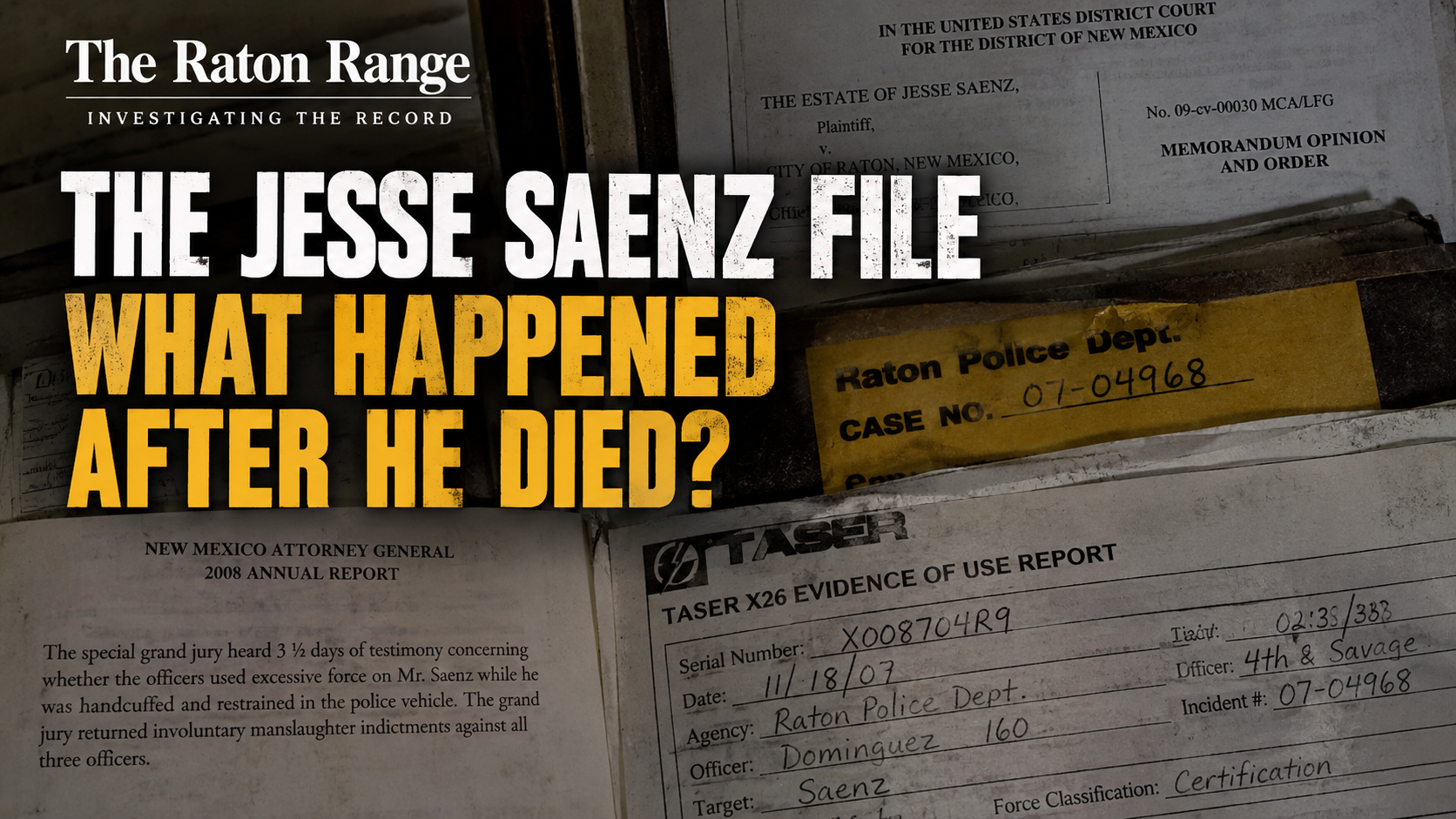
The legal proceedings continued. Saenz’s estate pursued a federal civil-rights lawsuit. In that case, a federal judge determined that the evidence concerning the repeated use of Tasers could support a finding that the force used was excessive. The court did not determine that Dominguez was criminally responsible for Saenz’s death, and it did not resolve every disputed question surrounding the encounter.
That distinction matters.
So does the other part of the story.
Three Raton officers, including Nolberto “Beto” Dominguez, were indicted for involuntary manslaughter in December 2008. The criminal case ultimately ended after a later medical conclusion attributed Saenz’s death to cocaine intoxication rather than restraint or Taser use.
But a dismissed criminal prosecution does not automatically restore public trust.
That is one of the most important questions surrounding this entire history:
What happened to the community’s trust in law enforcement after Jesse Saenz died?
For many people in Raton, that question never really went away.
And now, nearly two decades later, one of the officers involved in that case is seeking to lead a county law-enforcement agency.
Dominguez has since continued his law-enforcement career. He has described himself publicly as having 18 years of law-enforcement experience in Colfax County, including 11 years with the Raton Police Department and subsequent service with the Colfax County Sheriff’s Office. His campaign emphasizes experience, accountability, training, and transparency.
That record deserves to be examined alongside the history.
Not erased.
Not exaggerated.
Examined.
Because leadership of a sheriff’s office is not simply about how many years someone has worn a badge.
It is also about judgment.
It is about accountability.
It is about how an agency responds when something goes terribly wrong.
And it is about whether a community believes its law-enforcement leadership understands the difference between enforcing the law and maintaining the public trust.
The Jesse Saenz case remains relevant precisely because those questions were never confined to one night.
They became questions about Raton itself.
There were families who grieved.
There were officers whose lives changed.
There was litigation.
There were competing medical conclusions.
There were criminal charges.
There were questions about the amount of force used.
And there was a community left to decide what all of it meant.
That is the part of this story that can get lost when political campaigns reduce a complicated history to a few talking points.
Jesse Saenz was a human being before he became a case number.
He had family.
He had people who loved him.
He had people who expected him to come home.
And almost 20 years later, those people still live with his absence.
That is the human cost of this story.
The question facing Colfax County now is not whether anyone can rewrite what happened in 2007.
Nobody can.
The question is whether the community is willing to look back at the entire record, understand what the courts actually decided, understand what they did not decide, and ask what those lessons mean for law enforcement leadership today.
That is where the Jesse Saenz story belongs in 2026.
Not buried.
Not forgotten.
And not rewritten.
The record should speak for itself.
And the community should be allowed to decide what it means.