
By Roger M. Rael
The Raton Range
The death of Jesse Saenz did not end when the 23-year-old Raton man died after being arrested by Raton police in November 2007.
What followed was a complicated trail of police reports, internal investigations, medical reviews, a special grand jury, criminal charges, federal civil rights litigation and, eventually, a reported $1 million settlement.
Nearly 19 years later, one of the officers involved, Beto Dominguez, is a candidate for Colfax County sheriff.
That makes the record surrounding Saenz relevant to the 2026 sheriff’s race.
So does another law enforcement record involving the other major-party candidate, Republican Cody Ayon.
The two cases are not the same. They occurred years apart, involved different circumstances, and ended differently.
But both records involve the use of force by law enforcement officers and questions about how those incidents were investigated and resolved.
This story examines what the documents actually show.
WHAT HAPPENED AFTER SAENZ DIED?
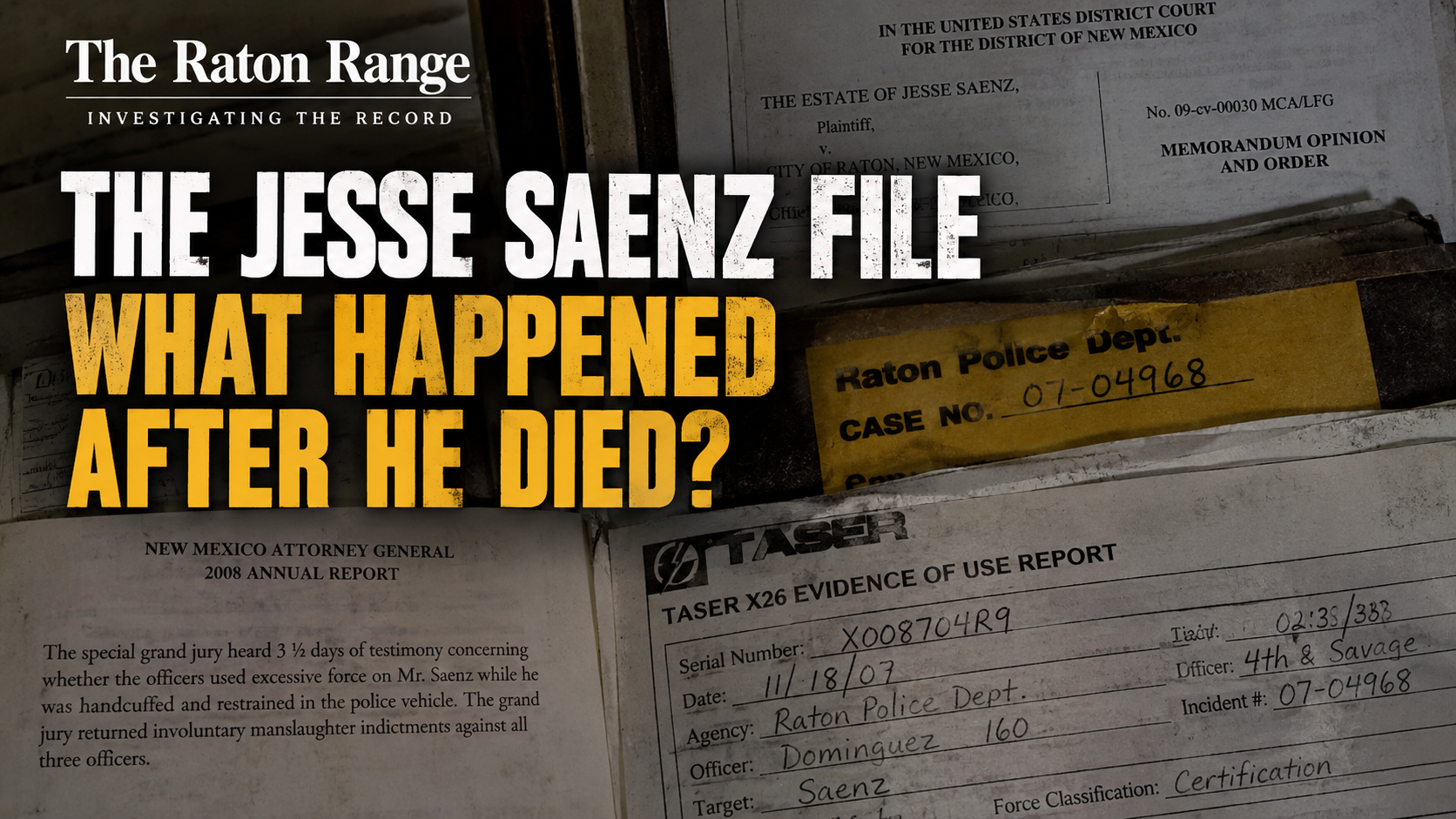
According to the records reviewed by The Raton Range, the City of Raton began compiling documentation surrounding Saenz’s death, including police reports, supplemental reports, radio logs, correspondence, medical records, and legal documents.
A 149-page city packet contains records concerning the death, including correspondence involving the city manager, police chief, the family, LULAC, the New Mexico Office of the Medical Investigator, and attorneys.
The records also show that the city manager directed the police chief to begin an internal investigation.
The death quickly became a matter of public concern.
Members of Saenz’s family and supporters sought answers, including through a prayer vigil and communications with city officials.
But the most consequential questions eventually centered on how Saenz died.
THE MEDICAL RECORD CHANGED
One of the most important developments came from the medical investigation.
The original medical conclusion reportedly identified cocaine intoxication and police restraint as contributing factors and classified the manner of death as homicide.
Later, another medical investigator reached a different conclusion.
That later opinion reportedly concluded that the officers’ actions, including the use of Tasers and restraint, did not contribute to Saenz’s death and that cocaine intoxication was the cause.
That change became central to what happened next.
The later investigator did not participate in the original examination and relied on existing evidence and records.
The difference between the medical conclusions is important because the public record does not simply contain one uncontested medical explanation for Saenz’s death.
It contains competing conclusions.
A GRAND JURY INDICTED THREE OFFICERS
In December 2008, a special grand jury indicted three Raton police officers in connection with Saenz’s death.
Those officers were Beto Dominguez, Leonard Baca Jr. and Chris Edmondson.
The charge was involuntary manslaughter.
The case, however, never went to a criminal trial.
In December 2009, the charges were dismissed following the later medical opinion that concluded the officers’ actions did not contribute to Saenz’s death.
There was no criminal conviction against the officers arising from Saenz’s death.
That distinction matters.
An indictment is not a conviction, and the dismissal of criminal charges is not the same thing as a jury verdict resolving every factual question surrounding an incident.
THE FEDERAL COURT CASE
The legal fight did not end with the dismissal of the criminal charges.
Saenz’s estate pursued a federal civil rights lawsuit.
In May 2010, a federal judge issued an opinion addressing the claims against the officers.
The court dismissed some claims but allowed an excessive-force claim involving the Tasers to proceed.
The federal court said a reasonable jury could find that Saenz did not present an immediate threat at the time the Tasers were being used.
The court also said a reasonable jury could conclude that more than 20 electrical cycles were delivered by the two Tasers while Saenz was barefoot, handcuffed, shackled at the legs, and lying face down in the back of a police vehicle.
The court did not decide that the officers were criminally guilty.
It also did not resolve every disputed question about the physical restraint of Saenz or the medical cause of his death.
Those issues remained disputed.
THE TASER RECORD
Testimony reviewed by the federal court showed that one Taser cycled 10 times and the other cycled 11 times.
That is why the federal court referred to the possibility of more than 20 electrical cycles.
Some contemporary accounts referred to 23 Taser activations or firings.
The distinction is important because a Taser activation is not necessarily identical to a proven electrical cycle through a person’s body.
The underlying records therefore need to be described precisely.
What is not in dispute is that multiple Taser cycles occurred during the arrest.
WHAT HAPPENED WITH THE RESTRAINT?
Another disputed issue involved how Saenz was restrained after he was handcuffed and shackled.
The estate alleged that Dominguez placed weight on Saenz while officers pulled his legs toward his handcuffed hands.
The officers disputed that account.
The federal court did not resolve that factual dispute at summary judgment.
That means the court did not make a final factual finding that Dominguez intentionally placed his weight on Saenz in the manner alleged.
Nor did the court issue a finding clearing Dominguez of the allegation.
The issue remained disputed.
THE CASE ENDED WITH A SETTLEMENT
The federal litigation ultimately ended with a reported $1 million settlement.
There was no jury verdict.
A settlement resolves litigation, but it does not by itself establish that every allegation made by the plaintiff was proven.
It also does not constitute a criminal conviction.
For the Saenz family, however, the settlement brought the federal litigation to an end.
For the public record, it left several questions unresolved because the disputed issues were never presented to a jury for a final verdict.
NOW LOOK AT THE OTHER CANDIDATE
The Saenz case involves one of the candidates now seeking the Colfax County sheriff’s office.
The other major-party candidate, Republican Cody Ayon, also has a documented use-of-force incident in his law enforcement record.
It happened in June 2019 at the Loaf ‘N Jug in Raton.
According to the records, Ayon encountered Kevin Hoy at the store.
Ayon reported that Hoy raised a finger close to his face, squared his posture, and appeared to present an imminent threat of battery.
Ayon said he knocked Hoy’s hand away and attempted to arrest him.
Officer Kenneth Long reported seeing Hoy swing.
Hoy gave a different account.
He said Ayon followed him after telling him he was free to leave, then struck his hand and chin before Hoy responded.
A civilian witness told Sgt. Bill LaPorte that the brown-uniformed officer appeared to strike first.
Another witness said the person could not determine who shoved first.
STORE VIDEO BECAME PART OF THE RECORD
LaPorte reviewed store surveillance video as part of the investigation.
His report stated that Ayon approached Hoy, moved closer, and struck Hoy in the upper body near the face after Hoy raised his right hand.
The video, however, did not clearly establish whether Hoy was pointing his finger or exactly where the contact landed.
Hoy was handcuffed and complained of wrist and shoulder pain and shortness of breath.
Emergency medical personnel evaluated him.
He refused additional treatment and transportation.
Hoy was booked on two counts of assault on a peace officer and resisting, evading or obstructing an officer.
The records reviewed for this story do not establish the ultimate court disposition of those charges.
THE INTERNAL AFFAIRS INVESTIGATION
The Raton Police Department opened an internal affairs investigation into the incident.
The investigation was identified as IA-002.
The evidence list included body-camera footage, store surveillance video, cellphone video, photographs, written statements, and interviews.
Ayon was later served notice of the administrative investigation after returning from injury or sick leave.
He resigned from the department the following day, citing health reasons, before the planned administrative interview could take place.
The internal investigation was closed with the finding of “undetermined.”
That word is important.
It does not mean the department determined Ayon committed misconduct.
It also does not mean the investigation exonerated him.
The administrative investigation was not completed because Ayon resigned before the process could be finished.
TWO RECORDS, DIFFERENT ENDINGS
The records involving Dominguez and Ayon therefore have important differences.
The Saenz case resulted in a special grand jury indictment, dismissal of criminal charges, federal civil rights litigation, and a reported settlement.
The Ayon incident resulted in an internal affairs investigation that was closed as undetermined after Ayon resigned before the administrative process was completed.
Neither record should be described as something it was not.
The Saenz indictment was not a conviction.
The federal court’s ruling was not a criminal finding of guilt.
The $1 million settlement was not a jury verdict.
The Ayon internal affairs case was not a finding of guilt.
And an undetermined administrative finding is not an exoneration.
WHAT THE RECORD SHOWS
The documents do establish that both candidates have law enforcement records involving allegations or disputes concerning the use of force.
In the Saenz case, the public record establishes that multiple Tasers were used against a handcuffed and shackled man, that the federal court found the excessive-force claim could proceed, that three officers were indicted for involuntary manslaughter, and that the criminal charges were later dismissed.
It also establishes that the medical conclusions changed and that the federal civil case ended in a settlement rather than a trial verdict.
In the Ayon case, the record establishes that a physical confrontation occurred, that witnesses provided conflicting accounts about who initiated the physical contact, that video evidence was reviewed, that an internal affairs investigation was opened, and that the investigation ended as undetermined after Ayon resigned.
Those are the documented facts.
WHAT REMAINS TO BE ANSWERED?
The records also leave questions.
In the Saenz case, additional records could provide a fuller picture of the original investigation, including the complete New Mexico State Police investigation, Taser evidence and downloads, Office of the Medical Investigator records and correspondence, criminal case records, and the complete federal litigation record.
The same principle applies to the Ayon case.
A complete record would include the underlying video evidence, the internal affairs investigative file, witness statements, administrative records, and any final court disposition involving the charges against Hoy.
The public should be able to distinguish between what is documented, what was alleged, what investigators concluded, and what was never resolved.
THE 2026 SHERIFF’S RACE
The 2026 Colfax County sheriff’s race now places both records in the public spotlight.
Democrat Beto Dominguez and Republican Cody Ayon emerged from their respective primary elections as their parties’ nominees for sheriff.
Their histories in law enforcement are part of the public record.
So are the investigations that followed the incidents examined here.
The purpose of examining those records is not to replace the documents with campaign rhetoric.
It is the opposite.
The purpose is to put the documents on the table and allow voters to see what happened, what was investigated, what was disputed, what was resolved, and what was never resolved.
That distinction becomes particularly important when the public is being asked to place authority in the hands of a sheriff.
A sheriff has the power to oversee deputies, establish expectations for the use of force, manage investigations, and respond to allegations involving members of the department.
That makes a candidate’s documented law enforcement history relevant.
It also makes accuracy essential.
THE RECORD IS NOT THE RHETORIC
Nearly two decades after Jesse Saenz died, the questions surrounding his death remain tied to a complicated record.
There was an arrest.
There was the use of force.
There were competing accounts.
There were competing medical conclusions.
There was a criminal indictment.
There was a dismissal.
There was federal litigation.
There was a settlement.
And there were factual questions that never received a final jury determination.
The Ayon-Hoy incident followed a different path.
There was a confrontation.
There were conflicting accounts.
There was video evidence.
There was an internal affairs investigation.
And that investigation ended as undetermined after Ayon resigned before it could be completed.
Those records do not answer every question.
But they provide something more valuable than campaign rhetoric: a documented starting point.
As voters consider the 2026 Colfax County sheriff’s race, the relevant question is not simply what either candidate or supporter says about the past.
The question is what the complete record shows about how force was used, how incidents were investigated, and what accountability followed.
That is where the documents lead.
And that is where Part 4 will continue.