
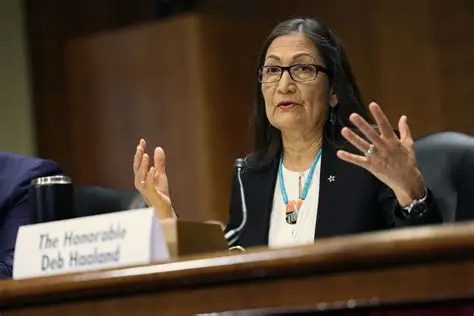
The Questions New Mexico Voters Still Have for Deb Haaland
By Roger Rael
The Raton Range Sept. 25, 2026 5:07 pm MST
As New Mexico’s gubernatorial race moves toward early voting, one question is becoming increasingly difficult for voters to avoid:
What will Deb Haaland have to answer before New Mexicans decide whether she is ready to lead the state?
Haaland, the Democratic nominee and former U.S. representative and U.S. interior secretary, has built her campaign around her experience in Washington, her record in public office and her promise to protect New Mexico’s water, land and communities.
But in recent weeks, several issues have put additional questions in front of voters.
The most immediate is the growing dispute over debates.
Haaland and Republican nominee Gregg Hull have yet to agree on a televised debate. KOB announced an Oct. 8 debate, but Haaland’s campaign said the date did not work because of prior commitments. Haaland’s campaign has said it proposed eight dates during negotiations, while Hull has maintained that he is available to debate. The Albuquerque Journal reported that KRQE also invited the candidates to debate and that Haaland’s campaign declined that invitation.
On Sept. 22, Haaland proposed a statewide debate involving KOB, KRQE, KOAT, KKOB and KVIA on Oct. 12, 13 or 14. Hull responded that he remained committed to the Oct. 8 KOB debate.
The result is that New Mexico voters are approaching early voting, which begins Oct. 6, without a confirmed traditional televised debate between the two major-party nominees.
That raises a straightforward question for Haaland:
If voters are interviewing the candidates for the state’s top job, when will they get to watch both candidates answer the same questions, side by side?
The data center question
Another issue has become even more complicated.
Haaland has proposed a day-one moratorium on new large-scale data centers until the state establishes additional protections involving water, electricity, environmental standards, tribal consultation, labor and community involvement.
The proposal comes amid intense controversy surrounding Project Jupiter, the massive data center development planned in Doña Ana County.
But campaign finance records have created an awkward question for Haaland.
Searchlight New Mexico reported that Oracle America contributed $12,400 to Haaland’s campaign and that individuals whose identifying information matches executives associated with Oracle and data center construction company Clayco contributed at least another $74,800.
Haaland was subsequently asked how voters could be assured that she would fairly regulate an industry from which her campaign had received money.
Her response was that she could “walk and chew gum at the same time” and that campaign contributions would not determine her priorities. She said she had not discussed returning the money at that point but would discuss it with her team.
That leaves voters with a legitimate question:
If the data center industry is important enough to warrant a day-one moratorium, should companies and executives connected to that industry be contributing to the campaign of the person who could ultimately regulate them?
Haaland says the answer is that she can accept campaign contributions while still acting independently.
Her critics disagree.
The question now belongs to the voters.
What about Washington?
Haaland’s four years as secretary of the Interior under President Joe Biden are another part of her record that voters can examine.
Haaland has presented her federal experience as an asset, particularly when dealing with federal agencies and programs that affect New Mexico.
But that experience also creates another question:
How much of the Biden administration’s record should voters associate with Haaland, and what would she do differently as governor?
That question is particularly relevant in a state where issues involving federal land, energy, water, Native American affairs, oil and gas, and rural economic development frequently collide.
Haaland has emphasized her ability to work with the federal government. During a recent NewsNation interview, she pointed to her experience in Congress and at Interior while discussing her qualifications to lead the state.
For voters, however, experience is only one part of the equation.
The other part is what a candidate intends to do with that experience.
Is Haaland campaigning enough in New Mexico?
There has also been criticism surrounding Haaland’s participation in campaign forums.
The Albuquerque Journal reported that Hull and Haaland have appeared together at only one candidate forum since the June primary. Hull has criticized Haaland’s absence from several events, while Haaland’s campaign has argued that she has spent substantial time traveling throughout the state and meeting voters.
Haaland has also sent her running mate, outgoing State Land Commissioner Stephanie Garcia Richard, to represent the campaign at some events.
That has produced another question:
When voters have an opportunity to hear directly from the person seeking to become governor, should they expect the candidate herself to be there?
There is a practical reason that question matters.
A governor does not get to send someone else to answer every difficult question.
The money question
There is another reality of this campaign that voters cannot ignore: money.
Haaland’s campaign reported raising more than $3.4 million during the latest reporting period, while Hull reported raising approximately $943,000.
Haaland has raised considerably more money than her Republican opponent.
That gives her campaign the ability to communicate with voters through television, digital advertising, mail and other campaign operations on a scale Hull cannot easily match.
But money does not answer policy questions.
It doesn’t explain how the state will deal with its water challenges.
It doesn’t tell parents what will happen in their schools.
It doesn’t tell rural communities what economic development will look like.
And it doesn’t tell voters how a Haaland administration would be different from the federal administration she served.
Those are questions only the candidates can answer.
What should New Mexico voters ask?
The debate controversy, the data center donations, and Haaland’s federal record point toward a larger issue.
New Mexicans aren’t simply choosing a name on a ballot.
They are choosing someone who will be responsible for the state’s budget, public education, economic development, health care, public safety, water policy, and relationship with the federal government.
So perhaps the most important questions for Haaland are also the simplest:
What would you do differently from the administrations before you?
How will you protect New Mexico’s water while allowing communities to grow?
What is your position on Project Jupiter today, and would that position change if you became governor?
Will you return campaign contributions from companies or executives whose industries you intend to regulate?
How will you work with rural New Mexico, where economic opportunities and challenges can look very different from Albuquerque and Santa Fe?
What is your plan for improving public education?
What is your plan for reducing the cost of living?
What will you do about crime and public safety?
What specifically will you do as governor that could not be accomplished during your time in Washington?
And perhaps the question hanging over the debate controversy:
When will New Mexicans get to watch Deb Haaland and Gregg Hull answer those questions together, without campaign staff speaking for them?
Haaland has said she is willing to debate. Hull has said he is willing to debate. Both campaigns say the other side is responsible for the scheduling breakdown.
But early voting begins Oct. 6.
The clock is moving.
And New Mexico voters still have questions.