

In November 2007, 23-year-old Jesse Saenz died shortly after being arrested by Raton police.
Court records show Saenz was handcuffed, his ankles were shackled, and he was subjected to repeated Taser cycles before being placed face down in the back of a patrol vehicle for the trip to the police station. A Taser instructor later testified that one officer’s device recorded 10 cycles and another recorded 11. The federal court said the evidence could support a finding that Saenz experienced more than 20 electrical cycles.
But the story did not end with Saenz’s death.
The case produced conflicting medical conclusions, an involuntary manslaughter indictment of three Raton police officers, federal civil-rights litigation and a court ruling that allowed a jury to consider whether the Taser force used against Saenz was excessive.
The night Jesse Saenz died
The incident began during the early morning hours of Nov. 18, 2007, after a 911 call reporting an argument.
Raton officers Leonard Baca Jr., Nolberto “Beto” Dominguez, and Sgt. Chris Edmondson responded.
According to the federal court record, officers had probable cause to arrest Saenz for criminal trespass. Saenz was eventually handcuffed. The court record says he did not fight at the moment he was initially handcuffed, although he later resisted efforts to put him inside a patrol car.
That resistance became the central part of the officers’ explanation for what happened next.
Saenz wedged himself in the doorway of the patrol vehicle and kicked as officers attempted to get him inside. Dominguez came around to the opposite side of the vehicle, opened the door, and grabbed Saenz by the torso, pulling him into the car.
The officers removed Saenz’s boots and shackled his ankles.
Then the Tasers were used.
The federal court noted that the officers’ accounts differed about exactly when the Tasers were used and how many times they were activated. The electronic evidence also became important.
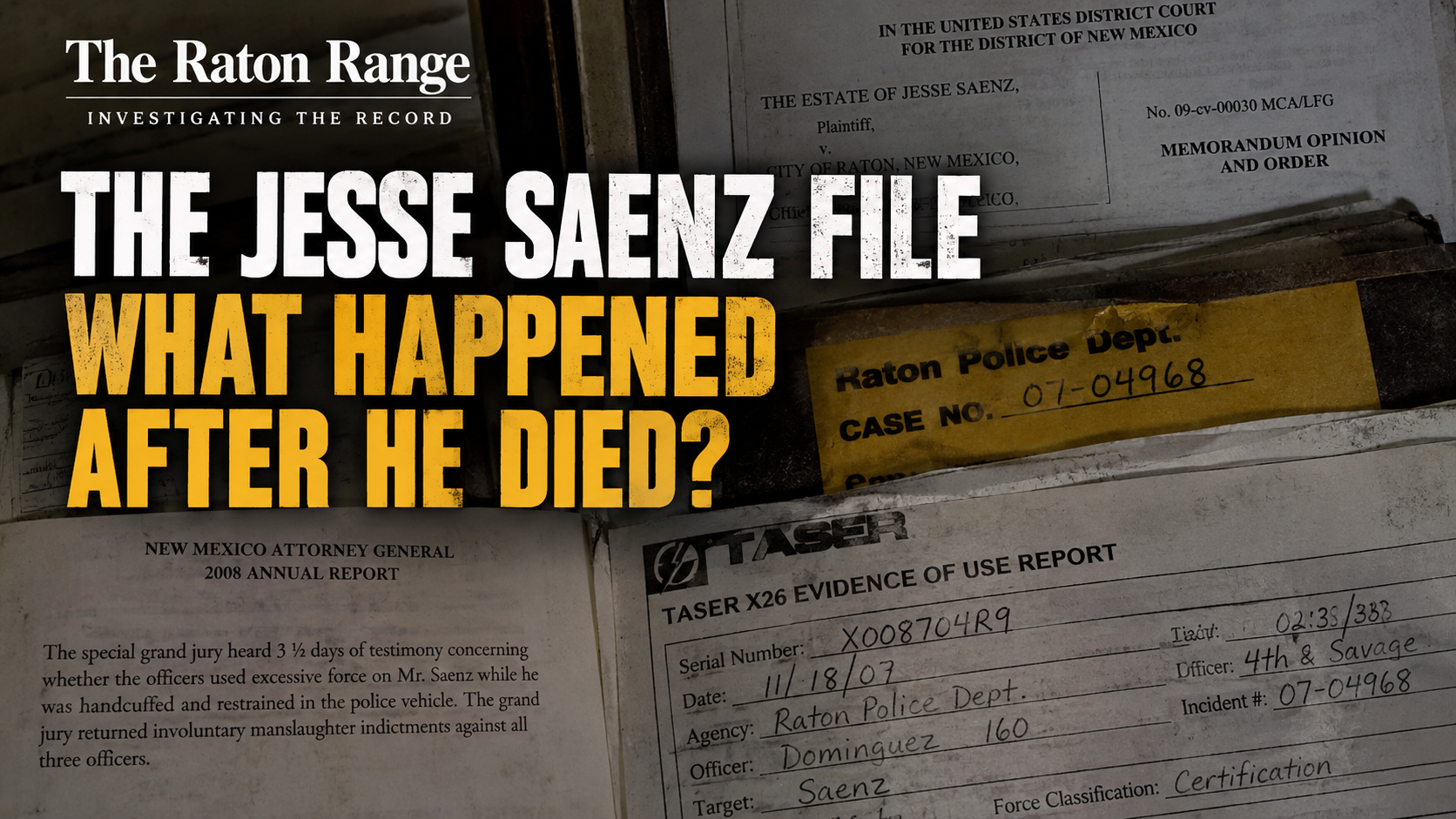
A Taser instructor who reviewed the devices testified that Baca’s Taser recorded 10 cycles and Dominguez’s recorded 11. The court therefore found that a reasonable jury could conclude that Saenz was subjected to more than 20 electrical cycles.
That is different from saying that 23 shocks were definitively proven. Contemporary accounts referred to 23 Taser activations or firings, while the federal court focused on the electronic cycle evidence.
What happened inside the police car?
This is where the record becomes more complicated.
The court record establishes that Saenz ended up face down in the back of the patrol vehicle, with his hands cuffed behind him and his ankles shackled.
What happened to his body during the trip was disputed.
Saenz’s estate alleged that Dominguez placed his weight on Saenz’s neck, back and/or buttocks while pulling Saenz’s shackled ankles toward his cuffed hands.
The officers disputed that account. Their testimony described Dominguez as holding Saenz’s legs while keeping his weight off Saenz’s back.
The federal judge did not decide which version was correct at that stage of the case.
That distinction matters.
The allegation about Dominguez’s body position should not be presented as a fact that a court ultimately proved. It was a disputed account that became part of the civil litigation.
What is not disputed is that Saenz was transported face down, restrained with handcuffs and ankle shackles, and died shortly afterward; perhaps if Dominguez’s training had been used, this tragedy may not have happened. New Mexico law enforcement training specifically addresses the dangers of positional asphyxia when people are restrained. New Mexico training standards include instruction on the dangers of positional asphyxia and on safely moving a handcuffed person out of the prone position.
The concern is that transporting a restrained person face-down, or prone, can interfere with breathing and increase the risk of serious medical complications or death. New Mexico law enforcement policies have likewise warned that leaving a restrained person lying face-down can create a risk of positional asphyxia.
For that reason, officers are trained to recognize the dangers of keeping a restrained person in a prone, chest-down position and to move the person into a position that allows normal breathing as soon as reasonably possible.
The medical conclusions changed
The medical findings became one of the most consequential parts of the case.
The original medical investigation reportedly concluded that Saenz’s death was a homicide and identified cocaine intoxication as the cause, with physical restraint contributing to the death.
A later medical investigator reached a different conclusion.
That investigator concluded that the Tasers and restraint did not contribute to Saenz’s death and attributed the death to cocaine intoxication. The later investigator had not participated in the original autopsy and relied on evidence that had already been collected.
The change in medical conclusion had a major effect on the criminal case.
In December 2008, a special grand jury indicted three Raton police officers, including Dominguez, on involuntary manslaughter charges. The New Mexico Attorney General’s 2008 annual report confirms that the grand jury considered whether the officers used excessive force on Saenz while he was handcuffed and restrained in the police vehicle.
The charges were later dismissed after the new medical conclusion was issued.
The dismissal meant the criminal prosecution ended. It did not resolve every factual disagreement surrounding the arrest.
The federal court case
Saenz’s estate also pursued a federal civil-rights lawsuit against the city and officers.
That case produced a significant ruling in 2010.
The federal judge did not determine that Dominguez or the other officers were criminally responsible for Saenz’s death. Instead, the court considered whether the evidence, viewed under the legal standard applicable at that stage, could support claims of excessive force.
On the Taser claim, the judge concluded that a reasonable jury could find that Saenz did not pose an immediate threat at the point in question and that the amount of force alleged could have been objectively unreasonable.
The court therefore denied qualified immunity on that particular excessive-force claim.
The judge did not resolve the separate disputes over the physical restraint or the precise medical cause of death.
Those distinctions are important because the public record contains several different conclusions about the case, and they should not be collapsed into one statement.
A question that remains
The 150-page City of Raton records packet reviewed by The Raton Range contains extensive material concerning the death, the investigation, the Tasers, complaints, and subsequent legal proceedings.
But in that packet, the Range did not find a documented interview question specifically asking Dominguez why the Taser was repeatedly activated.
That does not establish that no investigator ever asked him that question. The packet is not necessarily the complete New Mexico State Police investigative file.
But it raises a straightforward question about the record:
What explanation did Dominguez give for each additional Taser activation, and what circumstances did investigators document as justification for the continued use of the device?
That question becomes particularly significant because the electronic evidence documented repeated cycles from two separate Tasers.
What the record establishes
The Jesse Saenz case has been described in different ways over the years. The underlying documents allow a more precise account.
Saenz died after being arrested by Raton police.
He was handcuffed and later shackled at the ankles. He was subjected to repeated Taser cycles. He was placed face down in a police vehicle and transported in that position.
The officers’ accounts differed on portions of the encounter, particularly the use of the Tasers and the physical restraint inside the vehicle.
The original medical conclusion and the later medical conclusion differed over the role of restraint and the cause of death.
Three officers were indicted for involuntary manslaughter, and the charges were later dismissed.
And in the subsequent federal lawsuit, a judge found sufficient evidence for the Taser excessive-force claim to proceed toward a jury, while leaving other disputed questions unresolved.
The record does not establish that Dominguez was convicted of causing Saenz’s death.
It also does not erase the documented questions surrounding the force used that night.
Those are two separate facts, and both belong in the public record.
The complete documents tell a much larger story than a headline ever could