

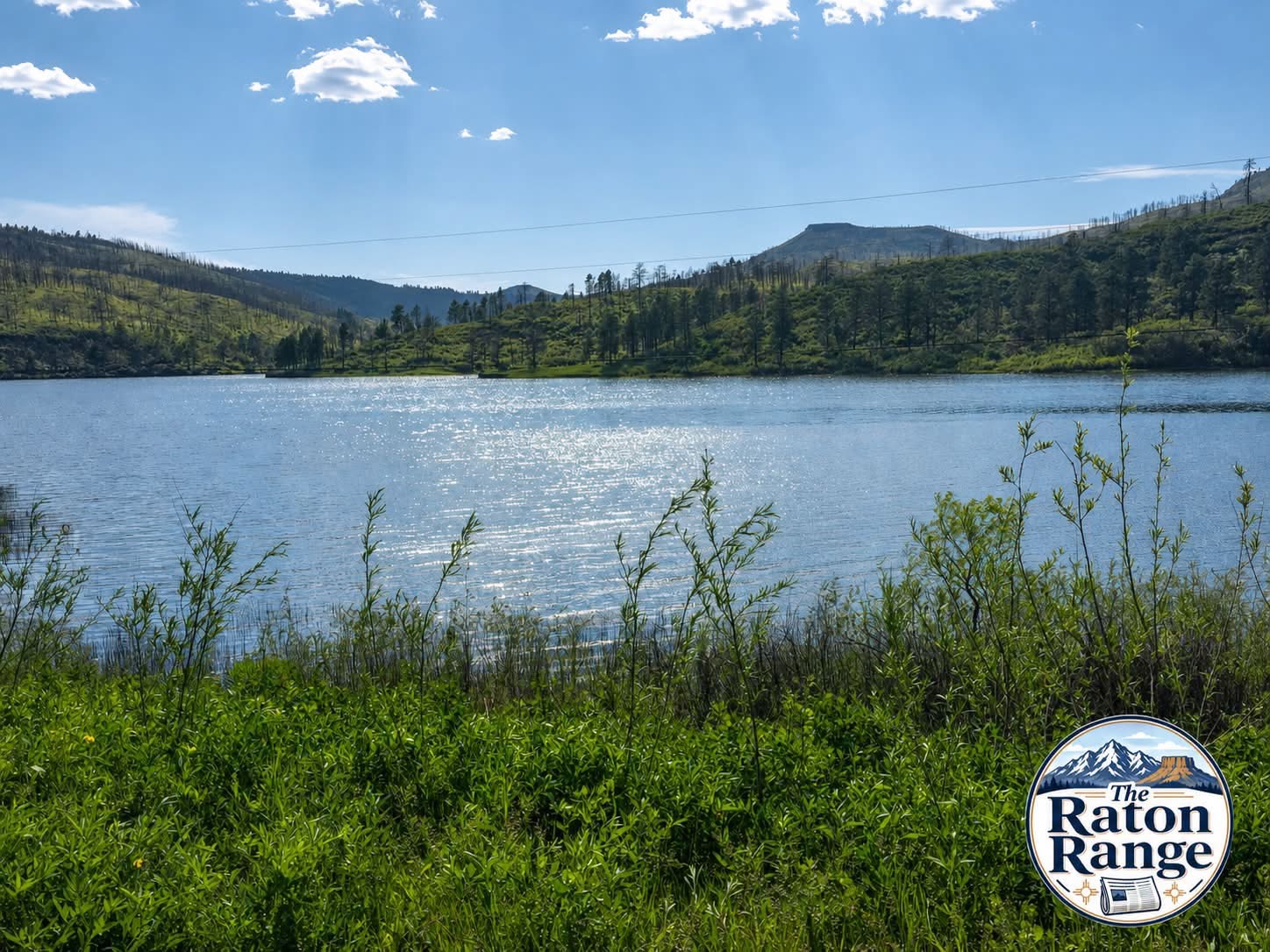
Federal records show the decline continued into August as drought grips Colfax County and Denver orders sprinklers shut down
By ROGER RAEL
THE RATON RANGE
RATON — Lake Maloya’s stored water dropped by approximately 8.15 million gallons in just seven days during July.
That is the number. Here is the question:
Where did it go? Did someone keister it?
Was it aliens from outer space, and their ship overheated and they needed water to cool it down? Who knows, but it’s about time to start asking serious questions about our water supply. Believe me, I have been asking and still no answers. What I did find out will shock you.
The federal gauge monitoring Lake Maloya recorded approximately 3,553 acre-feet of water on July 21. By July 28, storage had fallen to approximately 3,528 acre-feet—a decline of 25 acre-feet, or 8,146,275 gallons.
Eight million gallons is not a rounding error; that’s an alarm, and someone better start talkin’.
If $8 million in public money went unaccounted for in one week, auditors, elected officials, and law enforcement officers would be asking questions immediately. Water is not cash, and a declining reservoir does not mean water was stolen or wasted. But in a drought-stricken community, water may be even more valuable.
The story did not end July 28.
Provisional data from the U.S. Geological Survey showed Lake Maloya holding approximately 3,466 acre-feet on Aug. 22. That is another 62-acre-foot decline—roughly 20.2 million gallons—since July 28.
Measured from July 21 through Aug. 22, Lake Maloya’s stored volume fell by approximately 87 acre-feet, or more than 28 million gallons. The USGS cautions that its real-time figures are provisional and subject to revision, but the downward direction is clear. The monitoring station is operated in cooperation with the City of Raton and the New Mexico Office of the State Engineer. [USGS Lake Maloya monitoring station](https://waterdata.usgs.gov/nwis/uv?legacy=1&site_no=07199450)
That does not mean 28 million gallons were wasted. Reservoir storage is controlled by water coming in and water going out. Municipal withdrawals, evaporation, reservoir releases, and seepage all reduce storage. At the same time, drought and weak runoff can leave little new water flowing into the lake to replace what is removed.
But Raton residents have not been given a public breakdown showing how much of the decline came from each source.
How much water was taken from Lake Maloya for treatment? How much was delivered to customers? How much was lost to evaporation? Was water released from the reservoir? Were there major line breaks, leaks, hydrant use, or system flushing? How much treated water was lost before it reached customer meters?
And perhaps the most uncomfortable question: Where is the most water being used?
Residents do not need individual customer names. They need totals showing residential, commercial, industrial and government consumption. They also need to know how much water is being used on parks, public property and other large irrigated areas while the community’s primary water supply continues to fall.
The Cimarron Watershed Alliance, summarizing New Mexico State Engineer measurements, reported that 16 monitored drainages had no measurable flow. Nearly every remaining location was running at 2 cubic feet per second or less. The exception was Springer Ditch below Springer Lake, which was measured at 18.33 cubic feet per second.
Lake Maloya is Raton’s primary water source. The Cimarron River, supplied through Eagle Nest Lake, is another important source. Trouble in both watersheds ought to get everyone’s attention.
Federal drought information lists approximately 13,750 Colfax County residents—100% of the county’s population—as affected by drought. The county also experienced its 21st-driest January-through-July period in 132 years of records. [Drought.gov Colfax County conditions](https://www.drought.gov/states/new-mexico/county/colfax)
The Raton Range has made repeated attempts to contact Raton Water Works General Manager Lloyd Wakefield for current information about Lake Maloya, water consumption, system losses, and Raton’s drought response. Those calls and e-mails had not been returned as of publication time.
That silence leaves residents and this reporter trying to interpret federal gauge readings without the operational information held by Water Works. Talk about a time for transparency.
While Raton waits for answers, Denver has already moved from conservation requests to mandatory restrictions.
On Wednesday, the Denver Board of Water Commissioners ordered all lawn watering and spray irrigation to stop after Sept. 30. The prohibition takes effect Oct. 1 and will remain in place until the board acts again. Sprinklers will not automatically be allowed back on next spring.
Denver Water reported its reservoirs were 72% full as of Aug. 24, compared with a historic median of 94% for this time of year. Natural streamflow from April through July was only 22% of normal—the lowest recorded in 110 years. Officials estimate that stopping grass watering could preserve another 5,000 acre-feet before winter.
Trees, shrubs and gardens may still be watered by hand or through low-volume nonspray systems. Parks, school grounds, athletic fields and other heavily used grass areas must obtain an approved variance or water budget. Willful violations may bring fines of up to $2,000 or restrictions on water service. [Denver Water drought action](https://www.denverwater.org/tap/drought-conditions-worsen-denver-board-water-commissioners-declares-formal-end-lawn-watering)
Denver’s restrictions do not apply to Raton. They do, however, show how quickly a community can move from asking residents to conserve water to ordering them to stop watering altogether.
Raton should not wait for an emergency before explaining the numbers.
Water Works should release a complete water balance showing Lake Maloya’s inflow, withdrawals, evaporation estimates, releases and storage changes. It should also disclose Raton’s daily production, customer-category consumption, distribution-system losses and the conservation measures that would be triggered if conditions continue to worsen.
Eight million gallons did not disappear without a physical explanation. The water either left storage or was not replaced by incoming water.
The explanation may be ordinary municipal use combined with drought, heat, and weak runoff. It may reveal losses that need immediate attention. Until the figures are released, residents are left to guess.
Raton cannot conserve intelligently when the people responsible for its water will not explain where it is going.